Pearson Edexcel · GCSE · Psychology
Course version: 1PS0 · Version from Sept 2017
Understand the role of identity and free will in the development of self,…
Full specification wording
The self: 7.1.2 Understand the role of identity and free will in the development of self, including strengths and weaknesses of each theory: a. Erikson (1959) the eight stages of identity development b. Baumeister (2008) the consequence of belief in free will
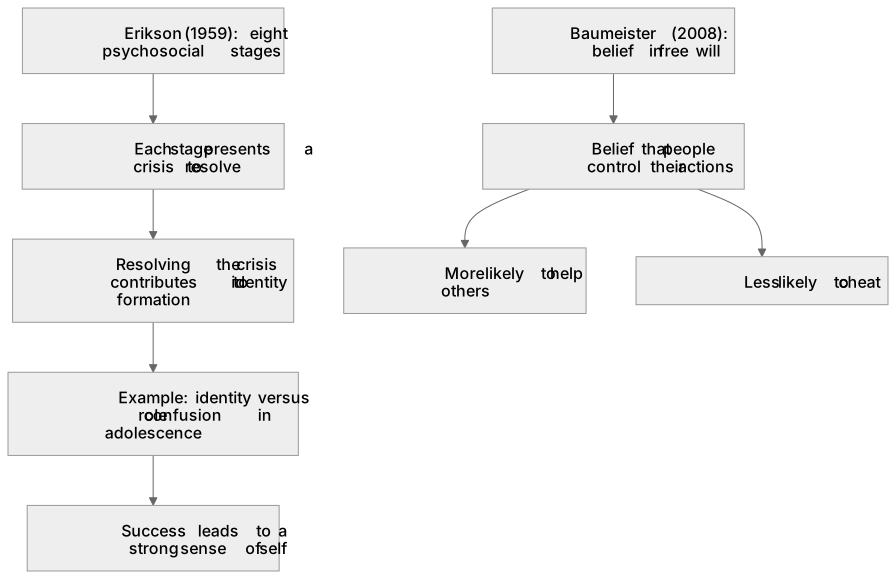
Erikson (1959) proposed that identity develops through eight psychosocial stages across the lifespan, each presenting a crisis to resolve.
Checked against the Pearson Edexcel 1PS0 specification (opens in a new tab) on .
- Point 2 of 6
- 3 key terms
Study notes
From the checked teaching notes for this specification point.
The idea
Erikson (1959) proposed that identity develops through eight psychosocial stages across the lifespan, each presenting a crisis to resolve. For example, adolescents face 'identity versus role confusion', where success leads to a strong sense of self. A strength is its lifespan approach; a weakness is its lack of empirical evidence. Baumeister (2008) explored the consequences of believing in free will, suggesting it promotes prosocial behaviour and personal accountability. When people believe they control their actions, they are more likely to help others and less likely to cheat. A strength is its application to improving societal behaviour, but a weakness is the difficulty in objectively measuring free will.
What earns the marks
- Identify Erikson's eight stages of psychosocial development and the concept of a psychosocial crisis.
- Explain how resolving crises at different stages contributes to identity formation.
- Describe Baumeister's (2008) findings on how belief in free will affects prosocial and antisocial behaviours.
- Evaluate Erikson's theory by discussing its strengths (e.g., lifespan perspective) and weaknesses (e.g., cultural bias).
- Evaluate Baumeister's theory by discussing its strengths (e.g., practical applications) and weaknesses (e.g., reliance on self-report).
Common mistakes and how to put them right
Confusing Erikson's psychosocial stages with Freud's psychosexual stages.
Put it right: Focus on social and identity crises (e.g., trust versus mistrust) rather than erogenous zones.
Assuming Baumeister proved free will exists.
Put it right: Baumeister studied the consequences of believing in free will, not whether free will itself is a scientific reality.
Failing to evaluate both theories.
Put it right: Ensure you can provide at least one strength and one weakness for both Erikson's and Baumeister's theories.
Exam tips
- Use specific examples of Erikson's stages, such as 'identity versus role confusion' in adolescence, to illustrate identity development.
- When evaluating Baumeister, mention how belief in free will can be manipulated in experiments to observe changes in cheating or helping behaviour.
- Clearly distinguish between the concepts of identity development (Erikson) and the behavioural consequences of free will beliefs (Baumeister).
Try the lesson
The start of the The self: 7.1.2 Understand the role of identity and free will in the development of self, including strengths and weaknesses of each theory: a. Erikson (1959) the eight stages of identity development b. Baumeister (2008) the consequence of belief in free will lesson, made from checked teaching notes for this specification point.
Have a go first
According to Baumeister (2008), what is a likely consequence of a person strongly believing in free will?
Listen
Erikson (1959) proposed that identity develops through eight psychosocial stages across the lifespan, each presenting a crisis to resolve. For example, adolescents face 'identity versus role confusion', where success leads to a strong sense of self. A strength is its lifespan approach; a weakness is its lack of empirical evidence. Baumeister (2008) explored the consequences of believing in free will, suggesting it promotes prosocial behaviour and personal accountability. When people believe they control their actions, they are more likely to help others and less likely to cheat. A strength is its application to improving societal behaviour, but a weakness is the difficulty in objectively measuring free will. A strong answer earns marks for these points. Identify Erikson's eight stages of psychosocial development and the concept of a psychosocial crisis. Explain how resolving crises at different stages contributes to identity formation. Describe Baumeister's (2008) findings on how belief in free will affects prosocial and antisocial behaviours. Evaluate Erikson's theory by discussing its strengths (e.g., lifespan perspective) and weaknesses (e.g., cultural bias). A common slip: Confusing Erikson's psychosocial stages with Freud's psychosexual stages. Instead, Focus on social and identity crises (e.g., trust versus mistrust) rather than erogenous zones. Exam tip: Use specific examples of Erikson's stages, such as 'identity versus role confusion' in adolescence, to illustrate identity development.
See it
Key words
Say what each word means before you turn the card.
Identity formation
Try answering aloud or in your head before turning the card.
Psychosocial development
Try answering aloud or in your head before turning the card.
Prosocial behaviour
Try answering aloud or in your head before turning the card.
See every definition
- Identity formation
- The development of a strong sense of self through resolving a series of psychosocial crises across the lifespan.
- Psychosocial development
- Development through eight stages across the lifespan, each presenting a crisis to resolve.
- Prosocial behaviour
- Helping others, which people are more likely to do when they believe they control their actions.
Label the diagram
Some boxes have lost their names. Pick the right name for each number.
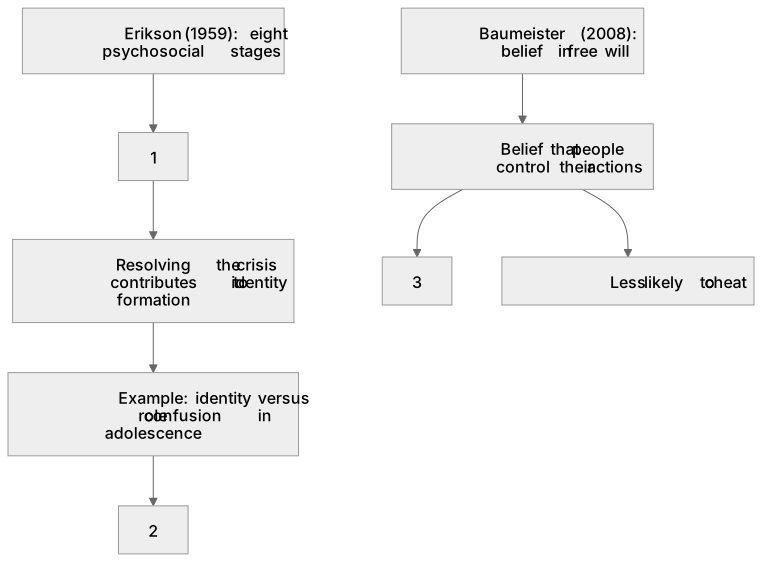
1Box 1
2Box 2
3Box 3
There is more to this lesson
The full lesson goes on to check your understanding and help you earn the marks. Create a free account to carry on, with your progress saved.
A week of Premium from your first lesson · Then the free plan continues · No card, no charge
Test your understanding of The self: 7.1.2 Understand the role of identity and free will in the development of self, including strengths and weaknesses of each theory: a. Erikson (1959) the eight stages of identity development b. Baumeister (2008) the consequence of belief in free will
Active recall beats re-reading. Take an instant quiz now to test what you’ve learned and lock it into long-term memory.
A week of Premium from your first lesson · Then the free plan continues · No card, no charge